1. The Critical Dilemma of Crypto Exchange 2FA
In the digital asset ecosystem, authentication is literally the difference between financial sovereignty and total liquidation. Whether you are actively trading perpetual futures on Binance and Bybit, accumulating low-cap altcoins on KuCoin, or executing cross-chain arbitrage on OKX, two-factor authentication (2FA) is a mandatory protocol requirement.
However, modern crypto traders face a severe paradox:
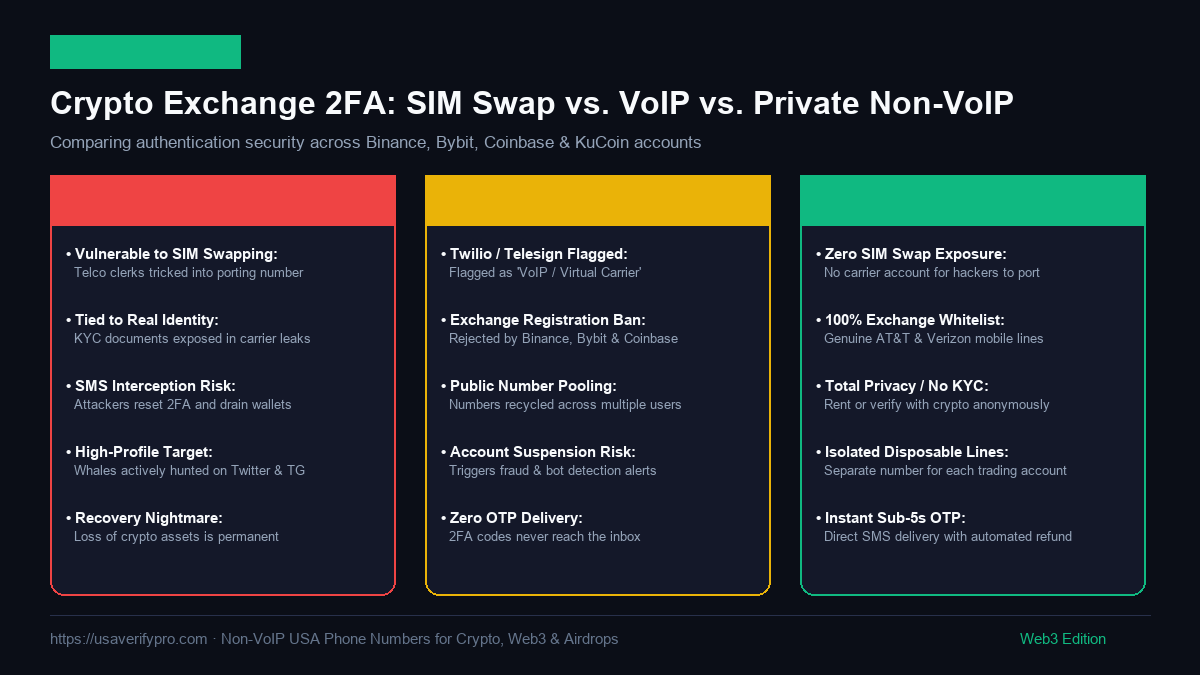
- If you use your personal everyday SIM card: You expose yourself to devastating SIM Swapping attacks. Hackers scour blockchain transactions, Twitter/X profiles, and Telegram alpha channels to identify high-net-worth individuals, bribe or manipulate wireless telecom customer service agents, port your phone number, and drain your exchange wallets in minutes.
- If you use free or virtual VoIP numbers (Google Voice, Skype, TextNow, Talkatone): The exchange immediately rejects your number at the registration or verification modal with generic error messages like "Invalid carrier type", "VoIP numbers not supported", or "Suspicious registration detected".
This blueprint breaks down the telecommunications architecture governing crypto compliance, provides step-by-step resolution paths for every major centralized exchange, and illustrates how to deploy private, cellular-grade non-VoIP numbers funded anonymously via cryptocurrency.
2. Why Exchanges Reject VoIP: The Line Type Intelligence (LTI) Engine
To understand why standard virtual numbers fail on exchanges, one must examine the automated compliance pipelines employed by tier-1 trading venues. Exchanges do not operate telecom networks; instead, they integrate real-time identity APIs provided by global telecommunications intelligence clearinghouses, primarily Telesign, Twilio Lookup v2, and Neustar.
When you input a phone number into Binance or Bybit, an asynchronous backend query is executed within milliseconds before any SMS packet is dispatched. The exchange evaluates three distinct carrier attributes:
| Carrier Attribute | Virtual VoIP (Google Voice / TextNow) | Physical Non-VoIP (USAVerify Pro) | Exchange Compliance Action |
|---|---|---|---|
| Line Type (LTI) | VOIP / FIXED_VOIP |
MOBILE / CELLULAR |
VoIP flagged as fraudulent bot; Mobile approved. |
| Operating Network | Bandwidth.com / Google Cloud Datacenter | AT&T Mobility / Verizon Wireless / T-Mobile | Datacenter ranges systematically blacklisted. |
| Porting Status (SPID) | CLEC (Competitive Local Exchange) | Tier-1 Wireless Operating Company | CLEC triggers instant automated rejection. |
| SMS Delivery Rate | 0% Delivery | 99.8% Sub-5s | Physical SIM captures high-priority OTP packets. |
Because VoIP lines can be mass-generated via automated Python scripts and APIs for fractions of a cent, cybercriminals utilize them to automate sybil accounts, manipulate order books, and launder illicit funds. Consequently, centralized exchanges enforce a strict, zero-tolerance algorithmic block on all non-cellular routing prefixes.
3. SIM Swap Threat Vectors: Why Your Personal Number Is a Liability
Many crypto enthusiasts believe that their personal AT&T or Verizon smartphone number is safe. Unfortunately, in the eyes of an organized crypto theft syndicate, your personal carrier account is the weakest link in your security chain.
Consider the standard attack vector:
- Target Profiling: The attacker discovers your email address through an exchange database leak (e.g., Ledger, CoinMarketCap, or Celsius breaches) or observes your activity in Telegram crypto trading groups.
- Identity Aggregation: Using your name and email, the attacker queries data broker caches to uncover your date of birth, home address, and primary cellular phone number.
- Carrier Social Engineering: The attacker contacts a low-wage customer support agent at your cellular provider's call center or walks into a retail franchise store posing as you. Claiming that their phone was "stolen while traveling", they persuade the representative to transfer your phone number to a new eSIM or physical SIM card in their possession.
- Wallet Drain: Within seconds, your real phone loses cellular signal ("No Service"). The attacker immediately initiates a "Forgot Password" or "Reset 2FA" request on Binance, receives the SMS authorization code on their device, disables your withdrawal locks, and drains your Bitcoin, Ethereum, and Solana balances into mixer protocols like Tornado Cash.
4. Exchange-by-Exchange Verification Blueprint (2026 Status)
Each major trading platform implements distinct validation criteria and fallback mechanisms. Below is our lab's audited breakdown of how each exchange handles phone verification and how to navigate it seamlessly:
A. Binance Global & Binance US
Binance enforces strict risk scoring powered by its proprietary anti-fraud engine alongside third-party telecom lookups. If a number exhibits high recycling velocity or originates from a known VoIP block (such as Bandwidth Inc. or Enflick), Binance returns: "Phone verification failed. Please try another phone number."
- Requirement: Clean US or Tier-1 European cellular mobile number.
- Optimal Strategy: Choose a private US non-VoIP line from USAVerify Pro under the Binance category. Enter the allocated number into Binance, hit "Get Code", and receive your 6-digit OTP in 2 to 4 seconds.
- Long-term Security: If you trade frequently and utilize SMS as a secondary withdrawal factor, utilize our Long-Term Number Rental to retain the same dedicated SIM line across weeks or months.
B. Bybit
Bybit has surged in popularity among derivatives and copy traders, but its security algorithms immediately freeze accounts that attempt phone binding with VoIP proxies. Bybit's SMS timeout is set to 60 seconds. If an SMS gateway experiences routing queue congestion, the code expires.
- Requirement: Direct carrier termination with latency under 5 seconds.
- USAVerify Pro Edge: Because our lines interface directly with physical SIM racks connected to AT&T and Verizon towers, OTP packets bypass public internet routing delays, appearing in your user dashboard in real time.
C. OKX & KuCoin
OKX and KuCoin are widely utilized by international altcoin traders and Web3 bot developers. Both platforms mandate SMS binding for enabling sub-account API key generation.
- Requirement: High carrier purity rating without previous association with frozen or banned accounts.
- Strategy: Never use free public SMS receiver websites. Public numbers have been used hundreds of times across crypto platforms and are permanently blacklisted. USAVerify allocates virgin, freshly-provisioned private lines for each order.
5. Step-by-Step: Verifying an Exchange with 100% Privacy
Follow this operational security (OpSec) protocol to register or verify your cryptocurrency exchange accounts while preserving total anonymity:
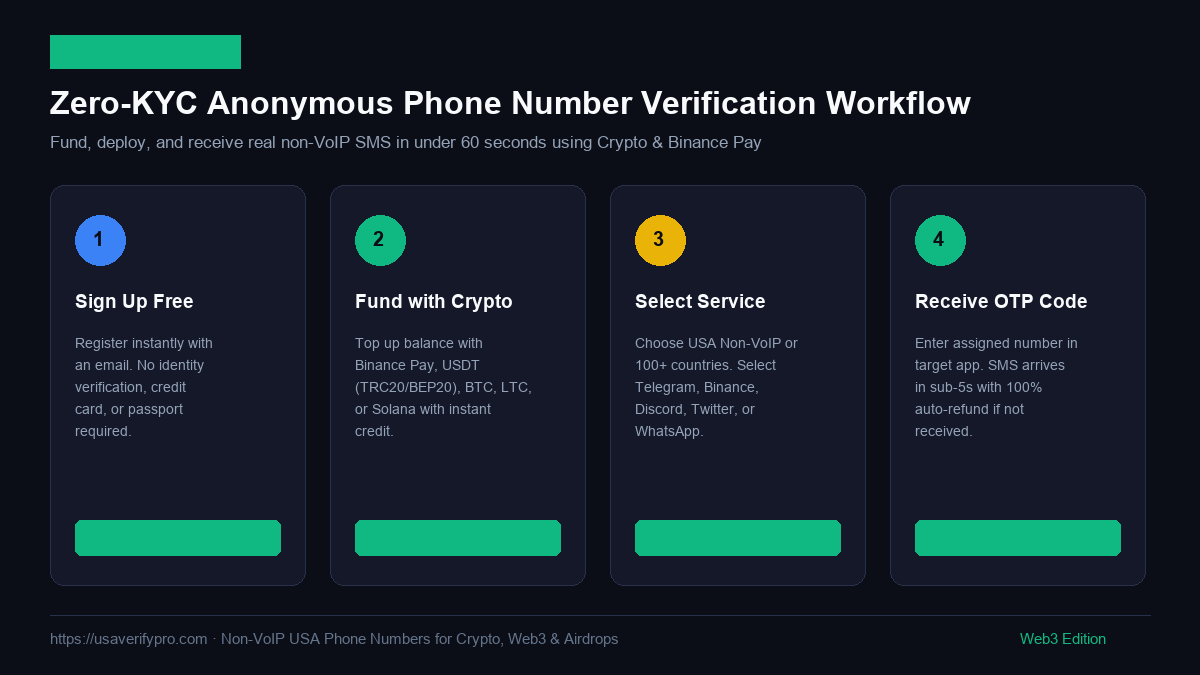
- Sign Up Anonymously: Navigate to USAVerify Pro Registration. Create an account using an alias email (e.g., ProtonMail, Tuta, or an aged Gmail from our Digital Store). No identity documents, physical addresses, or credit card numbers are ever requested.
- Fund with Crypto (Binance Pay / USDT): Head to your wallet balance. Select your preferred cryptocurrency. We support Binance Pay (zero gas fees, instantaneous confirmation), USDT (TRC-20 & BEP-20), Bitcoin (BTC), Litecoin (LTC), and Solana (SOL). Your account balance is credited automatically upon network confirmation.
- Select Target Exchange: In the SMS Catalog, choose United States (or your desired country) and select your target platform: Binance, Bybit, KuCoin, Coinbase, or Crypto.com.
- Deploy & Receive Live OTP: Your private physical SIM number is generated immediately. Paste the number into the exchange verification field. Click "Send SMS". Watch the USAVerify live terminal—your verification code appears within 3 to 5 seconds. Complete your exchange verification with 100% confidence.
6. The 3-Tier Crypto Account Hardening Matrix
While real non-VoIP SMS verification is critical for bypassing carrier filters and preventing SIM swap attacks, enterprise crypto security mandates defense-in-depth. We advise all serious traders to implement our three-tier hardening matrix:
| Security Layer | Technology Implemented | Primary Threat Mitigated | Implementation Complexity |
|---|---|---|---|
| Tier 1: Hardware 2FA | YubiKey 5C NFC / FIDO2 WebAuthn | Phishing websites & session hijacking | Medium (Requires physical USB key) |
| Tier 2: Private Non-VoIP | USAVerify Pro Cellular Numbers | Carrier SIM swap & dark web identity leaks | Low (Instant cloud activation) |
| Tier 3: Withdrawal Whitelists | Address Lock + 48-Hour Delay | Unauthorized wallet drains & malware | Low (Enabled within exchange settings) |
7. Frequently Asked Questions (FAQ)
Ready to Secure Your Crypto Exchange Accounts?
Bypass VoIP bans, prevent catastrophic SIM swaps, and verify your Binance, Bybit, or KuCoin account in under 60 seconds with real non-VoIP USA numbers.
Get Real Non-VoIP Numbers Now →