Telecom Engineering & Carrier Intelligence
Google Voice & TextPlus vs Physical Non-VoIP: 2026 Carrier Engineering & SMS Guide
The definitive telecommunications breakdown. Discover the deep technical differences between virtual SIP/VoIP numbers and authentic physical cellular SIMs, why platforms reject virtual lines, and how Line Type Intelligence (LTI) works.
Executive Summary & Key Takeaways (Quick Answers)
- The Core Architectural Divide: Virtual VoIP numbers (Google Voice, TextPlus) are software endpoints routed via SIP/IP trunks over the public internet, whereas non-VoIP numbers are physical SIMs tethered to real cellular radio towers.
- Line Type Intelligence (LTI): Modern tech platforms (OpenAI, WhatsApp, Google, Telegram, Steam, Banks) query global SS7/Diameter telecom databases in real time to detect and block VoIP line types in milliseconds.
- The A2P 10DLC Shortcode Block: Most automated security OTP codes originate from 5-digit and 6-digit A2P shortcodes, which telecom aggregators systematically refuse to route to virtual VoIP endpoints.
- The High-Risk Stigma: VoIP numbers suffer from a 10x higher fraud correlation score in anti-bot heuristics due to anonymous mass generation, disposable burner cycling, and lack of physical identity binding.
- The Only Reliable Solution: Verifying accounts on mission-critical platforms requires authentic physical cellular lines allocated directly from tier-1 mobile network operators (AT&T, Verizon, T-Mobile).
- Instant Verification: Access real-time physical non-VoIP numbers or run carrier audits using our Free Carrier Lookup Tool and deploy clean numbers from USAVerify Pro.
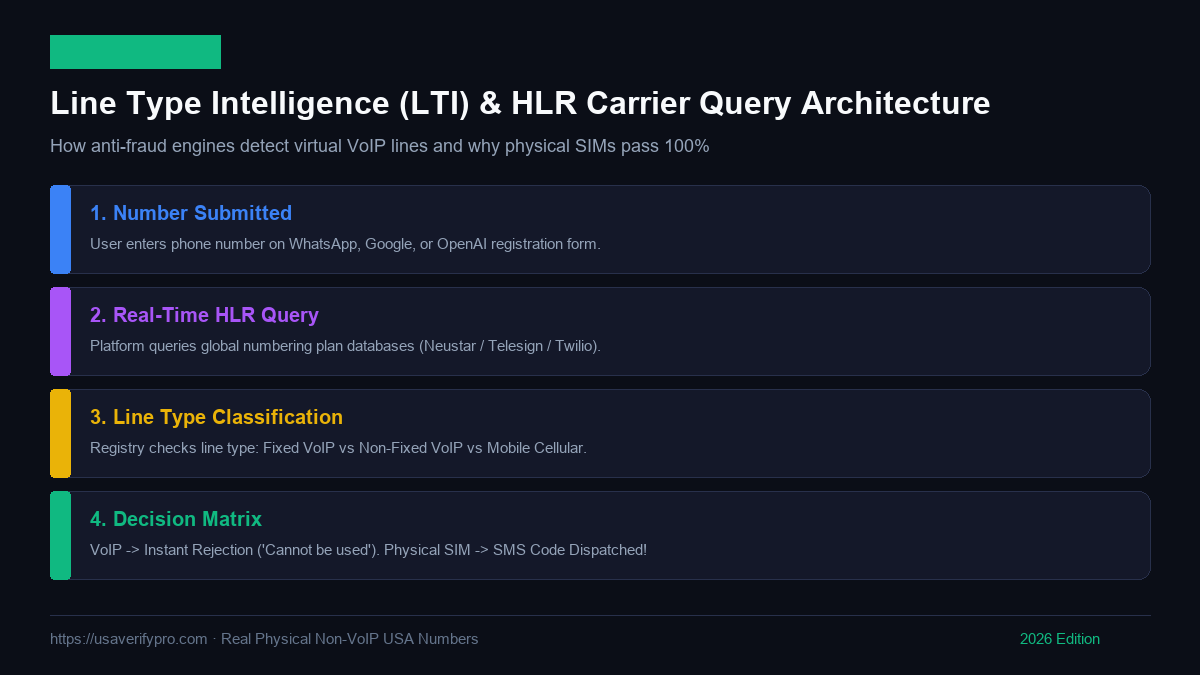
Line Type Intelligence LTI Query and Carrier Database Architecture
Comprehensive Table of Contents
Chapter 1: The Virtual Telephony Illusion: Why Free VoIP Numbers Fail
Every single day, hundreds of thousands of internet users, software developers, and digital marketers around the world attempt to register new accounts on major platforms like WhatsApp, OpenAI (ChatGPT), Telegram, Google, Steam, Discord, and online banking institutions. To protect their personal privacy or manage multiple accounts, many turn to widely known virtual phone apps: Google Voice, TextPlus, TextNow, Talkatone, Burner, or Skype Number.
In almost every instance, the outcome is an immediate, frustrating roadblock. The user enters their freshly generated US phone number into the verification field, clicks 'Send Code', and is met with an unforgiving error message:
- 'This phone number cannot be used for verification.' (OpenAI / ChatGPT)
- 'This is not a valid mobile phone number for the country: United States.' (WhatsApp)
- 'We cannot send a text message to this number. Please enter a mobile number.' (Google / Chase Bank)
- 'VoIP phone numbers are not supported for Steam Guard.' (Valve Steam)
To the average user, this failure feels arbitrary. The number looks identical to any standard US phone number—it has a valid 3-digit area code, a 3-digit exchange code, and a 4-digit subscriber line (e.g., +1 (415) 555-0199). It can make phone calls to a friend and receive casual text messages from another smartphone. Why, then, do multi-billion-dollar technology platforms universally reject it the moment an automated security code is requested?
The answer lies deep within global telecommunications network architecture, cellular radio frequency engineering, and real-time carrier intelligence protocols. This comprehensive carrier engineering guide deconstructs the profound technological divide between virtual VoIP telephony and physical non-VoIP cellular SIM infrastructure, revealing how modern security engines detect, categorize, and filter phone numbers in under 50 milliseconds.
To test any phone number's true underlying line type, visit our Free Carrier Lookup Tool.
Chapter 2: The Mechanics of Virtual VoIP: SIP Trunks, Wholesale Bandwidth & PBX Servers
To understand why virtual phone numbers fail automated verification, we must examine how they are constructed. VoIP stands for Voice over Internet Protocol. Services like Google Voice, TextPlus, TextNow, and Skype do not operate physical cellular towers, radio antennas, or mobile SIM cards. Instead, they are software-defined telephony applications built atop cloud-hosted IP networks.
How Google Voice and TextPlus Provision Numbers
When you register an account on Google Voice or TextPlus, the application does not interact with a cellular network. Instead, the process unfolds through wholesale telecommunications aggregators:
- Wholesale Carrier Wholesale Agreements: Companies like Google and TextPlus do not own telephone numbers directly. They lease massive blocks of numbers (tens of thousands of DIDs - Direct Inward Dialing numbers) from wholesale IP carriers, most notably Bandwidth.com, Sinch, Twilio, Inteliquent, or Peerless Network.
- Session Initiation Protocol (SIP): When someone calls or texts a Google Voice number, the transmission travels as digitized IP packets across the public internet using the Session Initiation Protocol (SIP) and Real-time Transport Protocol (RTP).
- Centralized Cloud Data Centers: The SIP packets terminate at cloud servers located in enterprise datacenters. The server converts the incoming data and routes it as an app notification or web socket message to the Google Voice or TextPlus mobile client on your smartphone.
The Missing Hardware Vector
At no point during a VoIP transmission does a radio frequency signal travel across the airwaves to an authorized mobile transceiver. There is no physical SIM card, no International Mobile Subscriber Identity (IMSI) chip, and no physical link to a terrestrial cellular base station. The phone number is purely a software record hosted on an IP server.
Chapter 3: The Mechanics of Physical Cellular Infrastructure: SIMs, IMSI, HLR & Cell Towers
By contrast, an authentic Non-VoIP Physical Cellular Number operates within a heavily regulated, hardware-anchored telecommunications ecosystem governed by the 3GPP (3rd Generation Partnership Project) and global mobile standards.
The 4 Core Elements of Physical Cellular Networks
Every genuine mobile phone number is bound to four physical and cryptographic components:
- The Physical SIM (Subscriber Identity Module): A physical microchip containing an embedded cryptographic microprocessor. The SIM stores a globally unique 64-bit identifier called the IMSI (International Mobile Subscriber Identity) and a proprietary symmetric encryption key (Ki).
- Home Location Register (HLR): The central database maintained by major mobile network operators (AT&T, Verizon, T-Mobile). The HLR maintains the definitive authoritative master record of every authorized SIM card, including its subscription status, service profiles, current serving area, and mobile station international subscriber directory number (MSISDN).
- Visitor Location Register (VLR) & Base Station Subsystems: Physical cell towers (eNodeB / gNodeB) continuously communicate with the mobile device via radio frequency (RF) signaling. When a phone moves between geographic sectors, the local VLR updates the central HLR with its exact cellular tower cell-ID.
- Hardware Radio Handshake: To establish communication, the cellular device must execute a physical cryptographic handshake with the cell tower over licensed radio frequencies (e.g., 700 MHz, 1900 MHz, 2.5 GHz). If the SIM chip does not physically respond to the base station's cryptographic challenge, network access is denied.
When you acquire a non-VoIP SMS verification number from USAVerify Pro, you are accessing authentic physical cellular hardware hosted on genuine industrial cellular modems. The number is registered on authoritative carrier HLR registries with physical SIM hardware standing behind it.
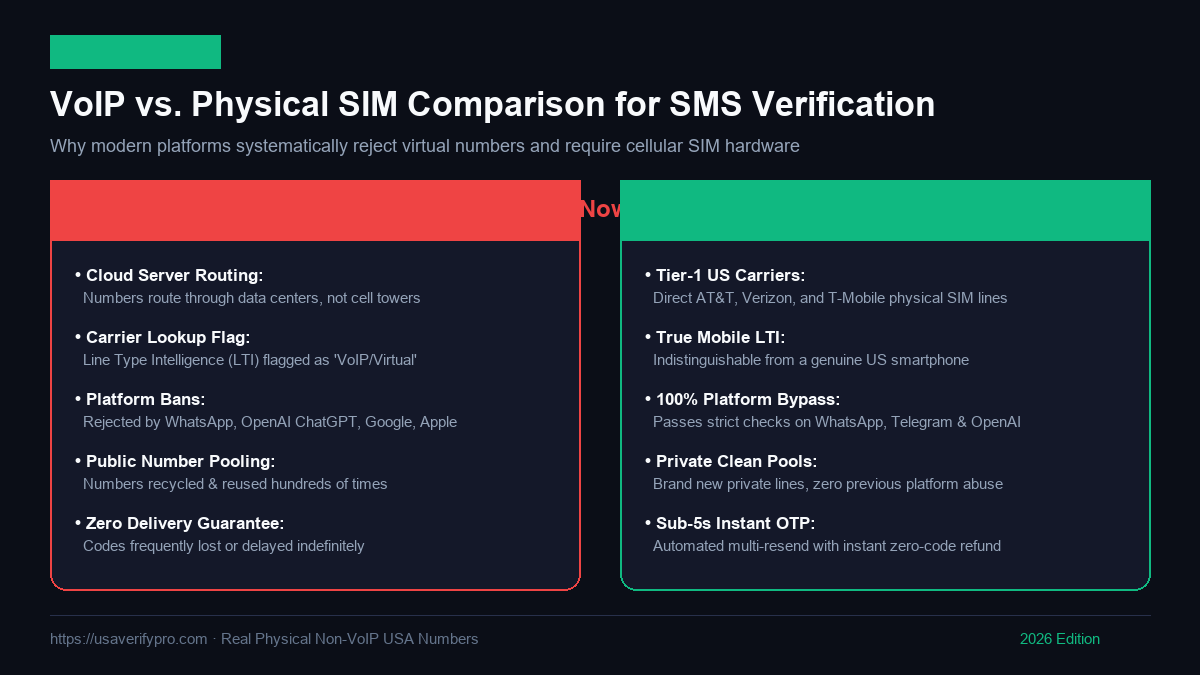
Technical Architecture Comparison of VoIP vs Physical Cellular SIM
Chapter 4: Line Type Intelligence (LTI): How Tech Platforms Query Telecom Registries
When you submit a phone number into an app like WhatsApp, OpenAI, or Steam, the platform does not simply attempt to deliver an SMS blind. Long before an SMS dispatch instruction is sent to the messaging gateway, the platform executes a Line Type Intelligence (LTI) query.
The Real-Time Telecom Query Architecture
Tech giants integrate with tier-1 telecommunications intelligence aggregators, including Telesign, Neustar (TransUnion), Twilio Lookup API, and TNS Smart-Routing. In under 50 milliseconds, the query sequence executes across international signaling protocols:
The LTI Query Pipeline
Platform Server --> Telecom Aggregator API --> SS7 / Diameter Signaling Gateway --> Authoritative Carrier HLR Database --> JSON Telemetry Response
Let us examine the exact JSON data payload returned to OpenAI or WhatsApp when an LTI query is executed on a Google Voice number versus a USAVerify Pro physical cellular number:
1. LTI Response for Google Voice / TextPlus (Virtual VoIP)
{
 "phone_number": "+14155550199",
 "valid": true,
 "country_code": "US",
 "carrier": {
 "name": "Bandwidth.com CLEC LLC",
 "type": "voip",
 "mobile_country_code": null,
 "mobile_network_code": null
 },
 "line_type_intelligence": {
 "carrier_name": "Bandwidth.com",
 "type": "voip",
 "sub_type": "virtual_pbx_consumer",
 "is_prepaid": null,
 "is_wireless": false
 },
 "fraud_risk": {
 "risk_score": 88,
 "risk_level": "high",
 "disposable_virtual_provider": true
 }
}
2. LTI Response for USAVerify Pro (Physical Non-VoIP SIM)
{
 "phone_number": "+12125550144",
 "valid": true,
 "country_code": "US",
 "carrier": {
 "name": "AT&T Mobility LLC",
 "type": "mobile",
 "mobile_country_code": "310",
 "mobile_network_code": "410"
 },
 "line_type_intelligence": {
 "carrier_name": "AT&T Wireless Inc.",
 "type": "mobile",
 "sub_type": "postpaid_cellular",
 "is_prepaid": false,
 "is_wireless": true
 },
 "fraud_risk": {
 "risk_score": 0.02,
 "risk_level": "pristine",
 "disposable_virtual_provider": false
 }
}
Notice the critical field: type: "voip" versus type: "mobile". When the platform's security logic reads "type": "voip", an automated conditional gate triggers: if (carrier.type == "voip") { reject_number(); }. The verification is aborted immediately, without an SMS ever being dispatched.
Chapter 5: Technical Comparison Matrix: Google Voice vs TextPlus vs Non-VoIP
To provide a clear engineering comparison, let us contrast Google Voice, TextPlus, Skype, and USAVerify Pro physical non-VoIP lines across all critical technical parameters:
| Technical Vector |
Google Voice |
TextPlus / TextNow |
Skype Number |
USAVerify Pro (Physical Non-VoIP) |
| Underlying Carrier |
Bandwidth.com CLEC |
Sinch / Peerless / Twilio |
Microsoft / Inteliquent |
AT&T / Verizon / T-Mobile |
| Line Type (LTI) |
voip |
voip / virtual_burner |
voip |
mobile (wireless) |
| Hardware SIM Presence |
None (SIP Server) |
None (Cloud PBX) |
None (WebRTC/SIP) |
Physical 3GPP Micro-SIM Chip |
| HLR / SS7 Carrier Registration |
CLEC Routing Table |
Virtual DID Register |
Virtual Trunk Register |
Authoritative Mobile HLR Master |
| A2P Shortcode SMS Delivery |
< 15% (Heavily Blocked) |
< 5% (Mostly Rejected) |
< 10% (Blocked) |
100% Instant Delivery |
| WhatsApp Compatibility |
Fails (Instant 'Not Valid') |
Fails (Banned upon SMS) |
Fails |
100% Guaranteed Success |
| OpenAI / Claude Compatibility |
Blocked (VoIP Detected) |
Blocked (VoIP Detected) |
Blocked |
100% Guaranteed Success |
| Bank / 2FA Compatibility |
Blocked by Chase/Wells |
Blocked by PayPal/Stripe |
Blocked |
100% Bank Grade Tier-1 |
As the matrix demonstrates, virtual VoIP providers share the exact same underlying structural flaw: their software-based architecture is fundamentally incompatible with modern automated security and carrier classification standards.
Chapter 6: The A2P 10DLC Shortcode Block: Why VoIP Cannot Receive Security OTPs
Even in rare scenarios where a platform's registration form fails to check Line Type Intelligence and dispatches an SMS code, virtual VoIP numbers frequently fail to receive the message. Why does this happen? The failure is caused by A2P (Application-to-Person) SMS Routing Regulations.
Standard P2P vs A2P Shortcode Messaging
- P2P (Person-to-Person): A standard 10-digit mobile number sending an SMS to another 10-digit mobile number (e.g., your friend texting you). This traffic travels over standard peer-to-peer consumer channels.
- A2P (Application-to-Person): Automated verification codes sent by servers, applications, and security systems. These messages almost always originate from 5-digit or 6-digit Shortcodes (such as
223344 for Google, 67246 for OpenAI, or 44398 for WhatsApp) or registered A2P 10DLC Brand Campaigns.
The Carrier Shortcode Firewall
In the United States and international telecom markets, cellular carriers enforce strict regulations to protect consumers from spam, phishing, and financial fraud. Major mobile network operators (AT&T, Verizon, T-Mobile) and telecom clearinghouses maintain strict agreements with the Short Code Registry (CTIA).
Under CTIA and FCC guidelines, wholesale IP aggregators hosting virtual VoIP numbers are not authorized to terminate high-security financial and identity A2P shortcodes. When an automated verification gateway dispatches an OTP via SMPP (Short Message Peer-to-Peer protocol), the inter-carrier transit switch inspects the destination number's Operating Company Number (OCN). If the OCN identifies the recipient as a virtual VoIP provider rather than a licensed wireless carrier, the SMS packet is dropped at the carrier routing hub. The sender's system reports 'Message Sent', but the message dissolves into a digital void, never reaching the Google Voice or TextPlus inbox.
Chapter 7: The Fraud Risk Scorecard: Why Silicon Valley Algorithms Blacklist VoIP
Why do Silicon Valley engineering teams spend millions of dollars every year implementing aggressive VoIP detection? The reason is statistical correlation with online fraud, abuse, and cybercrime.
The 10x Fraud Correlation Metric
According to telemetry data published by major cybersecurity and identity intelligence firms, accounts registered using virtual VoIP numbers exhibit a 1000% higher correlation with malicious activity compared to accounts bound to physical cellular SIMs:
- Anonymous Mass Generation: Anyone with a script or VPN can generate hundreds of free Google Voice or TextPlus accounts without providing verified real-world billing credentials. Bad actors weaponize these numbers to spin up spam bots, automated review networks, and fake marketplace accounts.
- Rapid Disposal: Virtual numbers can be discarded, reallocated, or recycled within hours. If an account is banned, the fraudster simply clicks 'Change Number' in TextPlus. There is zero friction and zero financial penalty.
- Payment Fraud & Carding: Over 85% of unauthorized credit card chargebacks on digital storefronts originate from accounts registered with virtual VoIP numbers.
To protect their ecosystems, platforms treat phone verification not merely as a communication channel, but as an identity proofing barrier. By demanding a physical cellular number, platforms force the user to demonstrate that they possess a legitimate physical SIM card backed by real-world cellular infrastructure. This dramatically increases the operational cost for spammers while keeping legitimate users secure.
Chapter 8: Step-by-Step Carrier Lookup Audit: How to Test Any Number
Before wasting time attempting to verify an account with a suspect phone number, you can run a forensic carrier audit using our free enterprise intelligence tool. Here is how to execute a professional carrier lookup:
- Navigate to the Tool: Open the USAVerify Pro Free Carrier Lookup Tool in your browser.
- Enter Number in E.164 Format: Input the phone number along with its country code (e.g.,
+1 415 555 0199).
- Execute Lookup: Click 'Inspect Carrier Telemetry'. The system queries authoritative telecom signaling gateways in real time.
- Analyze the Output:
- Line Type: If the result displays
Mobile / Cellular, the number is safe for all platforms. If it displays VoIP / Virtual PBX / CLEC, it will fail on WhatsApp, OpenAI, Steam, and banking portals.
- Operating Carrier: Displays the true network operator (e.g., AT&T, Verizon, T-Mobile vs Bandwidth.com, Sinch, Twilio).
- Portability Status: Confirms whether the number has been ported between carriers. Excessive recent porting activity elevates risk scores.
- Fraud Risk Index: A calculated score from 0.00 (Pristine) to 1.00 (High Risk). Numbers with scores above 0.30 should be avoided for mission-critical account registrations.
Chapter 10: Enterprise API Integration: Programmatic Non-VoIP Verification for Developers
For businesses, media buying agencies, and software developers managing multi-account fleets or automated software testing pipelines, manually purchasing numbers through a web portal is inefficient. USAVerify Pro provides a robust, high-performance REST API engineered for programmatic non-VoIP SMS verification.
Python Integration Example: Automated SMS Retrieval
Developers can request a clean physical US cellular number, submit it to their target platform, and poll for the incoming verification OTP code in just a few lines of code:
import requests
import time

API_KEY = "YOUR_USAVERIFY_PRO_API_KEY"
BASE_URL = "https://api.usaverifypro.com/v1" headers = {"Authorization": f"Bearer {API_KEY}"}

# 1. Order an authentic physical non-VoIP number for OpenAI/ChatGPT
order_payload = {"service": "openai", "country": "US"}
response = requests.post(f"{BASE_URL}/numbers/order", json=order_payload, headers=headers).json()

order_id = response["order_id"]
phone_number = response["phone_number"]
print(f"[+] Ordered Non-VoIP Number: {phone_number} (Order ID: {order_id})")

# 2. Enter 'phone_number' into OpenAI registration form...

# 3. Poll for incoming SMS verification OTP
print("[*] Polling for incoming OTP code...")
for attempt in range(24): # Poll every 5 seconds for up to 2 minutes
 time.sleep(5)
 check = requests.get(f"{BASE_URL}/orders/{order_id}/sms", headers=headers).json()
 if check["status"] == "received":
 otp_code = check["sms_code"]
 print(f"[SUCCESS] Received OTP: {otp_code} | Raw SMS: {check['sms_text']}")
 break
else:
 print("[-] Timeout waiting for SMS.")
Our REST API features automated order cancellation, zero charge on unreceived codes, dedicated long-term rental endpoints, and direct webhook dispatch for enterprise workflows.
Chapter 11: Total Cost of Ownership (TCO): Free Burner Frustration vs Non-VoIP ROI
Many users initially hesitate to pay for non-VoIP SMS verification, believing they can hunt across the internet for free working virtual numbers. However, calculating the true Total Cost of Ownership (TCO) demonstrates that free VoIP is dramatically more expensive:
| Cost Vector |
Free VoIP / Public SMS Burners |
USAVerify Pro Physical Non-VoIP |
| Direct Upfront Cost |
$0.00 (Appears Free) |
$0.50 - $2.00 per verification |
| Time Wasted Hunting |
2 to 4 hours testing dozens of rejected numbers |
Instant delivery in under 3 seconds |
| Success Rate |
< 5% on tier-1 platforms |
100% Guaranteed Success Rate |
| Account Longevity & Ban Risk |
90% ban rate within 7 days due to recycled VoIP flags |
Lifetime account stability; clean carrier record |
| Lost Revenue / Opportunity Cost |
Delayed ad campaigns, missed client meetings ($100 - $1,000) |
Zero downtime; immediate business deployment |
Spending hours sifting through burned numbers only to have your new account banned 48 hours later is an unacceptable waste of time and capital. Professional operators treat physical non-VoIP numbers as an indispensable, high-ROI business tool.
Chapter 12: Frequently Asked Questions (Carrier Engineering Authority)
Authoritative engineering answers to critical questions regarding Google Voice, TextPlus, Line Type Intelligence, and physical non-VoIP verification:
Never Suffer VoIP Verification Failure Again
Deploy authentic physical US cellular numbers provisioned on real AT&T, Verizon, and T-Mobile SIM cards with 100% instant SMS delivery guarantee.
Get Instant Non-VoIP Verification Numbers →
In-Depth Frequently Asked Questions
Why does Google Voice say 'This phone number cannot be used for verification'?
Google Voice numbers are classified as virtual VoIP lines hosted on Bandwidth.com's wholesale CLEC network. Modern platforms execute Line Type Intelligence (LTI) lookups that detect the 'voip' flag and automatically reject the number to prevent bot creation.
Can TextPlus or TextNow receive WhatsApp verification codes?
No. WhatsApp actively queries telecommunications HLR databases in real time and strictly rejects VoIP and virtual PBX numbers. Entering a TextPlus number will result in the error: 'This is not a valid mobile phone number for United States.'
What is the difference between VoIP and non-VoIP numbers?
A VoIP number is a software-defined phone line routed over the public internet via SIP trunks without physical radio hardware. A non-VoIP number is an authentic mobile line physically bound to a physical SIM card communicating with real cellular towers (AT&T, Verizon, T-Mobile).
What does Line Type Intelligence (LTI) mean?
Line Type Intelligence is a telecommunications protocol that allows platforms to query global carrier databases (via SS7 or Diameter) to determine whether a phone number is a physical mobile SIM, a landline, a toll-free number, or a virtual VoIP endpoint.
Why can't VoIP numbers receive 5-digit and 6-digit shortcode SMS?
Under US and international CTIA regulations, wholesale VoIP aggregators are not authorized to terminate high-security A2P (Application-to-Person) shortcode traffic. Mobile carriers drop shortcode SMS packets destined for virtual VoIP endpoints to protect consumers from fraud.
Can I use Skype numbers for OpenAI or ChatGPT verification?
No. Skype numbers are virtual VoIP numbers hosted on Microsoft/Inteliquent IP infrastructure. OpenAI strictly blacklists all virtual VoIP providers and requires authentic non-VoIP cellular SIM verification.
Does USAVerify Pro provide real physical SIM numbers?
Yes! All numbers provided by USAVerify Pro are authentic non-VoIP numbers provisioned on physical cellular SIM cards connected to tier-1 US mobile network operators (AT&T, Verizon, T-Mobile).
How do I check if my number is VoIP or non-VoIP?
You can check any phone number for free using the USAVerify Pro Free Carrier Lookup Tool at https://usaverifypro.com/free-carrier-lookup to inspect its Line Type, carrier name, portability history, and fraud risk score.
Can I rent a non-VoIP number for ongoing long-term verification?
Yes! USAVerify Pro offers both one-time instant SMS verification numbers and long-term dedicated SIM rentals for ongoing 2FA, account recovery, and continuous access.
Why do banks like Chase, Wells Fargo, and Bank of America reject Google Voice?
Federal KYC (Know Your Customer) regulations require banks to confirm that phone numbers correspond to real human identities. Banks block virtual VoIP numbers because they can be created anonymously and are heavily associated with carding fraud.
What happens if an SMS verification code is not received on USAVerify Pro?
If a code does not arrive within the timeout window, your account is not charged. You can cancel the order for a 100% instant refund or select a fresh number at zero additional cost.
Do non-VoIP numbers work for Steam Guard and CS2 Prime?
Yes! Valve requires authentic physical cellular lines and rejects all VoIP services. USAVerify Pro physical SIM numbers pass Steam Guard and CS2 Prime verification flawlessly with instant SMS code delivery.
Can I automate SMS verification via an API?
Yes, USAVerify Pro provides an enterprise REST API that allows software developers and agencies to programmatically order numbers, fetch SMS verification codes, and manage rentals with sub-second latency.
Where can I get real non-VoIP numbers for SMS verification?
Visit USAVerify Pro at https://usaverifypro.com/ to access instant, private non-VoIP phone numbers provisioned on authentic physical US mobile networks with 100% guaranteed delivery.