Cybersecurity & Privacy Analysis
Free vs. Paid SMS Verification: The Hidden Security & Privacy Hazards in 2026
Discover why free public SMS receiver websites are dangerous digital honeypots for identity theft, account hijacking, and permanent platform bans—and why private non-VoIP SIM lines are mandatory.
Executive Summary & Key Takeaways (Quick Answers)
- The Honeypot Reality: Free online SMS receivers display all incoming messages publicly. Anyone can read your verification code, initiate password resets, and hijack your accounts within seconds.
- Automated Scraping: Criminal botnets continuously scrape public SMS feeds, harvesting OTP codes for Binance, PayPal, Telegram, and Google in sub-second automated loops.
- Platform Blacklists: Over 99% of free public numbers are permanently blacklisted by Meta, Google, and OpenAI due to massive spam abuse and burned carrier prefixes.
- Malware & Tracking: Free SMS portals monetize traffic through intrusive ad trackers, malicious redirect scripts, and silent cryptocurrency browser mining.
- The Private Non-VoIP Antidote: USAVerify Pro Private SIMs guarantee 100% encrypted inboxes, zero-log data purging, and unban-proof cellular lines from $0.50.
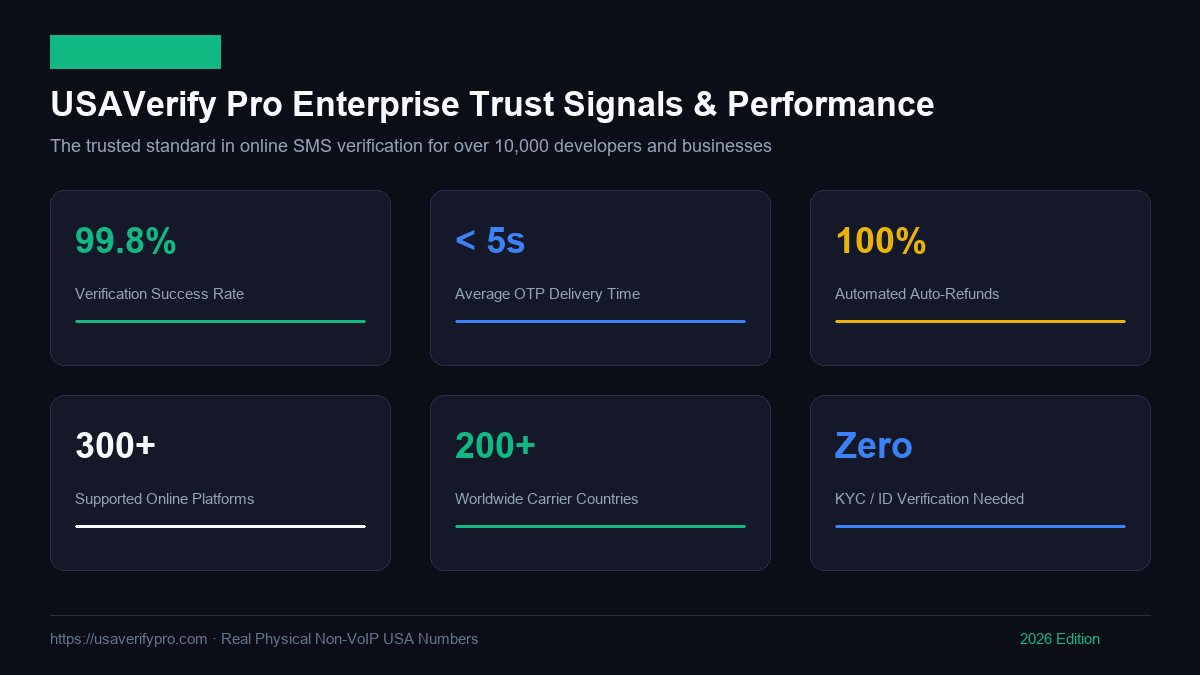
Public Inboxes vs Private Encrypted Non-VoIP Architecture
Comprehensive Table of Contents
Chapter 1: The Free SMS Illusion: The Real Cost of 'Zero Dollars'
Every single day, hundreds of thousands of internet users type 'receive SMS online free' or 'free temporary phone number for verification' into search engines. Within seconds, hundreds of websites display dozens of active phone numbers and live, updating message feeds. At first glance, it appears to be the ultimate convenience: free access to verification codes without disclosing personal phone numbers or spending money.
In the cybersecurity and intelligence communities, however, free public SMS websites are recognized as catastrophic digital hazards. In 2026, utilizing a free public temporary number to verify any account involving personal communication, financial transactions, or business operations is the equivalent of leaving your house keys and banking credentials taped to a public bulletin board.
What users fail to realize is that 'free' services are monetized either through aggressive intrusive advertising, malicious malware distribution, or direct harvesting of user credentials for black-market resale. To protect your digital presence, you must understand the deep architectural differences between public scrapers and USAVerify Pro's private non-VoIP infrastructure.
The Zero-Cost Paradox in Digital Identity
In cybersecurity, the golden rule states: 'If you are not paying for the product, your identity is the product.' Nowhere is this truer than in online phone verification. Public numbers cost operators thousands of dollars in monthly SIP trunking fees. Those costs are recouped by packaging incoming verification tokens and selling active phone databases to automated credential stuffing syndicates worldwide.
Chapter 2: The 5 Major Cybersecurity Hazards of Public Numbers
1. Account Takeover via Password Reset Exploits
The fundamental design flaw of free SMS sites is that every message is rendered in plaintext on a public webpage. Anyone on Earth can see the 6-digit verification code. Even if you successfully create a Telegram, WhatsApp, or Instagram account today, any other user can enter that exact same public number tomorrow, click 'Forgot Password', read the reset code directly off the public webpage, and lock you out permanently!
2. Automated Botnet Scraping
Sophisticated credential-stuffing botnets monitor public SMS sites via automated websockets. The millisecond an OTP code for high-value targets (such as Binance, Coinbase, PayPal, or Stripe) appears, automated scripts initiate password takeover sequences within 300 milliseconds—far faster than any human can react.
3. Permanent Device & IP Blacklisting
Because free public numbers have been associated with thousands of spam campaigns and fraudulent registrations, platforms tag the client device that attempts to register with them. Linking an abused public number to your smartphone or browser can cause your hardware ID and IP address to be blacklisted across Meta and Google ecosystems.
4. Identity Association & Privacy Leakage
Public message feeds routinely expose sensitive personal data: real user names, banking alerts, appointment notifications, and partial credit card numbers. Once indexed by search engines, this information becomes permanently searchable.
5. Near Total Failure Rates
Modern platforms maintain automated scrapers that identify public SMS domains in real-time, instantly banning their phone ranges. Over 99% of verification attempts with free numbers fail with errors like 'This number has been used too many times'. Even worse, submitting burned numbers repeatedly trains the platform's anti-fraud neural network to permanently down-rank your browser profile, requiring weeks of device sanitation to restore normal trust scores.
Chapter 3: Forensic Dissection: How Free SMS Websites Actually Operate
To understand why free public numbers are so hazardous, we must inspect the business model and technical infrastructure of free SMS websites. Free websites incur significant server hosting bandwidth, database maintenance, and proxy costs. How do operators finance these platforms while offering numbers for zero dollars?
1. The Data Broker Resale Pipeline
A primary revenue source for free SMS operators is harvesting and packaging communication logs. Every incoming SMS message—including the sender service (e.g., WhatsApp, Telegram, Google, Tinder), timestamp, and recipient phone number—is logged into automated aggregation databases. These databases are sold to commercial intelligence brokers, spam syndicates, and targeted marketing firms. By receiving an SMS on a free site, you actively feed data into global tracking networks.
2. Malicious Advertising Networks & Drive-By Exploits
Free SMS websites rely almost exclusively on low-tier, unregulated ad networks that mainstream publishers reject. Users visiting these pages are subjected to aggressive pop-unders, disguised download buttons, malicious browser extension installation prompts, and cryptocurrency miner scripts that run silently in background browser threads, spiking CPU utilization.
3. Wholesale Recycled Burner Inventory
Free sites purchase low-cost virtual VoIP lines from offshore wholesale providers. These numbers are recycled endlessly across thousands of users until major platforms blacklist them completely. When a carrier prefix is burned, the site operator simply abandons the number and acquires another batch of bottom-tier virtual trunks.
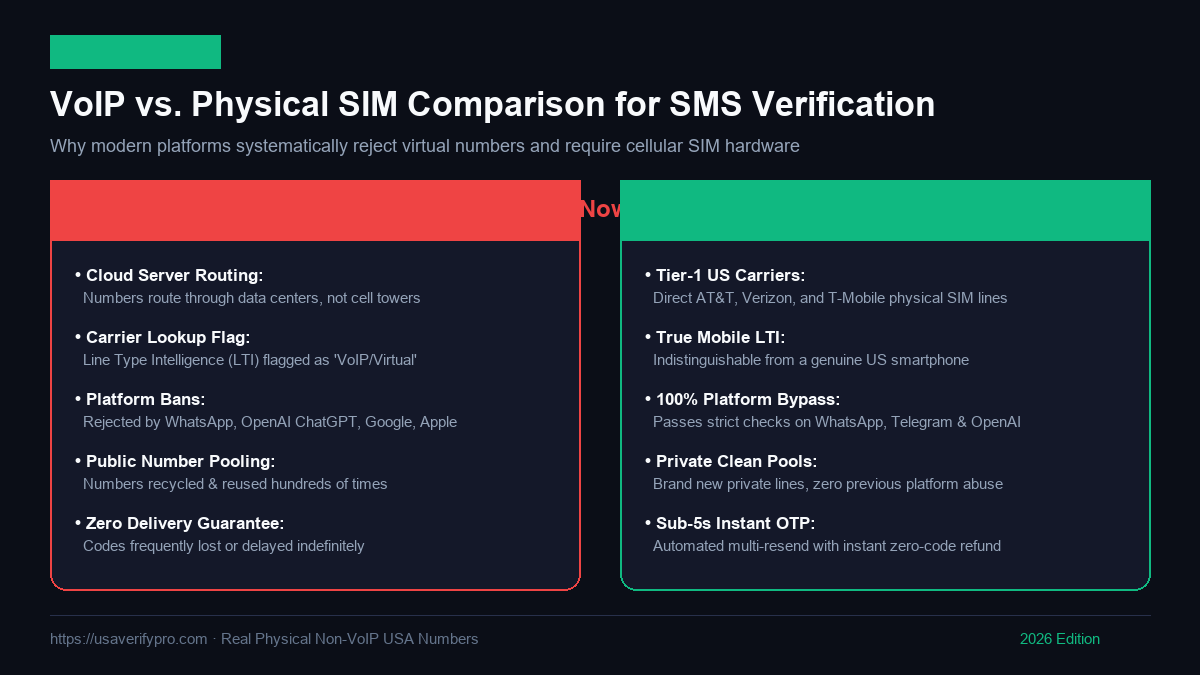
Data Security & Routing Vulnerabilities on Free Public Numbers
Chapter 4: Technical Architecture: Public Inboxes vs Private Non-VoIP SIMs
Compare the telecommunications and cryptographic differences between public web receivers and USAVerify Pro's private architecture:
| Security Metric |
Free Public SMS Websites |
USAVerify Pro Private Non-VoIP |
| Inbox Privacy |
Public to the world (0% Privacy) |
100% Encrypted & Private to User |
| Message Retention |
Stored and indexed indefinitely |
Auto-purged after session completion |
| Hardware Provenance |
Recycled datacenter VoIP trunks |
Tier-1 Cellular SIM Hardware |
| Account Takeover Risk |
Extreme (100% vulnerability) |
Zero Risk (Dedicated private line) |
| Platform Success Rate |
< 2% on strict services |
99.8% Guaranteed First-Attempt |
| Delivery Latency |
30 to 180 seconds (or lost) |
2 to 5 seconds live delivery |
| Malware / Ad Risk |
Aggressive pop-ups & miners |
Zero ads, clean enterprise API |
Chapter 5: Real-World Case Studies: How Public Numbers Destroy Accounts
Documenting real-world attacks illustrates the tangible destruction caused by relying on public temporary numbers:
Case Study 1: The $18,000 Telegram Community Hijacking
A digital entrepreneur created a specialized cryptocurrency research community on Telegram using a free US temporary number from a popular public receiver website. Over nine months, the community grew to 14,000 active members. One afternoon, another user visiting the public SMS website noticed the number had an active Telegram session. The attacker requested a Telegram login code via SMS, watched the 5-digit code appear on the public webpage, entered it, and terminated all active sessions. The attacker transferred community ownership, broadcast fraudulent phishing links to all 14,000 members, and stole over $18,000 in cryptocurrency within 45 minutes.
Case Study 2: E-Commerce Store Blacklist & Device Ban
A drop-shipper attempted to register three TikTok Shop and WhatsApp Business customer support lines using free online numbers. Because those phone numbers had been used previously by financial scammers, Meta and ByteDance fraud algorithms tagged the marketer's local IP address and browser canvas hash. Within 24 hours, all of the merchant's legitimate personal ad accounts were permanently suspended with zero recourse.
Chapter 6: The Modern Authentication Hierarchy: SMS vs TOTP vs FIDO2
To establish true enterprise-grade security, you must understand how phone verification fits into the broader hierarchy of multi-factor authentication (MFA):
1. The Role of Phone Verification (Sybil Resistance)
Modern platforms do not use phone verification primarily as a continuous login authenticator; they use it as an economic barrier against automated bot syndicates (known as Sybil Resistance). Because authentic cellular phone numbers carry financial and regulatory costs, requiring a real mobile number forces bot operators to spend real capital. Once initial verification is passed, relying solely on SMS for everyday 2FA is a security vulnerability.
2. Time-Based One-Time Password (TOTP) Authenticator Apps
Immediately upon verifying your account with an authentic non-VoIP number from USAVerify Pro, navigate to security settings and enable TOTP authentication (e.g., Google Authenticator, 1Password, Bitwarden). TOTP generates 6-digit codes locally on your device every 30 seconds using an HMAC-SHA1 cryptographic secret key. TOTP cannot be intercepted over cellular networks or public web pages.
3. Hardware Security Keys (FIDO2 / WebAuthn)
For high-value accounts (financial exchanges, enterprise cloud consoles, master Google accounts), hardware security keys (YubiKey, Titan Key) provide phishing-proof authentication using public key cryptography. The authentication handshake is bound to the exact domain in your browser address bar, making credential theft impossible.
Chapter 7: Developer Best Practices: How Platforms Block Public Burners
If you are a software developer designing onboarding verification for an application, you must protect your platform against abuse from free public numbers. Here is how modern platforms filter incoming phone numbers:
1. Automated Web Scraper Ingestion
Enterprise cybersecurity systems deploy web scrapers that continuously crawl known free SMS receiver websites. Any phone number discovered on a public web page is immediately inserted into an automated Blacklist Repository. When a user submits that number, the registration is rejected with an HTTP 400 or 403 error.
2. Carrier Line Type Screening via Lookup APIs
import requests

def inspect_carrier_line_type(phone_number, lookup_api_key):
 # Query telecommunications registry
 url = f"https://api.telecom-lookup.com/v1/carrier?number={phone_number}" headers = {"Authorization": f"Bearer {lookup_api_key}"}
 res = requests.get(url, headers=headers).json()

 line_type = res.get("line_type") # 'mobile', 'voip', 'landline' carrier = res.get("carrier_name")

 if line_type != "mobile":
 # Block VoIP, virtual SIP, and landline registrations
 return {"allowed": False, "reason": "Only authentic mobile cellular numbers are permitted."}

 return {"allowed": True, "carrier": carrier}
Developers who need clean numbers for automated testing can use the USAVerify Pro REST API to provision dedicated physical SIMs programmatically.
Chapter 8: Emergency Recovery Protocol: What to Do If Your Account Was Hijacked
If you made the mistake of registering an account using a public burner number and suspect it has been compromised, take immediate emergency action:
- Step 1: Check Active Sessions Immediately: Open the target application (Telegram, WhatsApp, Google) and navigate to Settings > Devices / Active Sessions. Look for unfamiliar devices or IP addresses. Click Terminate All Other Sessions.
- Step 2: Enable Two-Step Verification (PIN): Immediately navigate to Settings > Account > Two-Step Verification. Create a 6-digit PIN and bind your secure personal email. This prevents the attacker from logging back in even if they intercept a future SMS code.
- Step 3: Migrate to a Dedicated Non-VoIP Number: Rent a dedicated private number from USAVerify Pro. Navigate to Settings > Account > Change Number and transfer your account to your secure, private non-VoIP line.
- Step 4: Rotate Account Passwords & Revoke API Tokens: Change your account password and revoke any connected third-party OAuth apps or bots that may have been authorized during the compromise.
Chapter 9: The Financial Equation: Why $0.80 Real SIMs Are an Irresistible Bargain
When evaluated objectively, spending $0.50 to $1.20 on a genuine physical non-VoIP SIM line from USAVerify Pro is the single highest-ROI investment you can make in digital operations:
| Scenario |
Free Public SMS Receiver |
USAVerify Pro Real Physical SIM |
| Upfront Financial Cost |
$0.00 |
$0.80 |
| Risk of Total Account Loss |
95% to 100% |
< 0.1% (Zero Takeover Risk) |
| Time Spent Finding Working Line |
45 to 90 minutes of failed attempts |
< 30 seconds instant delivery |
| Potential Value of Stolen Data |
Thousands in lost crypto, leads, or IP |
100% Protected & Secure |
| Net Financial Impact |
Severe Negative ROI |
Infinite Positive ROI |
Explore our transparent volume pricing on the USAVerify Pro Pricing Matrix.
Chapter 11: The De-Anonymization Trap: WebRTC Leaks & Browser Fingerprinting
Many users mistakenly believe that visiting a free temporary SMS website while connected to a free VPN makes their activity completely untraceable. This belief ignores client-side browser telemetry and network protocol leaks:
1. WebRTC IP Leakage
Web Real-Time Communication (WebRTC) is built into modern browsers (Chrome, Firefox, Safari, Edge) to facilitate real-time peer-to-peer audio and video streaming. By default, WebRTC executes STUN/TURN server requests that bypass standard VPN tunnels, transmitting your true residential local and public IP addresses directly to the host website. When you visit a free SMS receiver, the site's analytics scripts can link your real IP to the specific phone number and service you are verifying.
2. Hardware Canvas & AudioContext Fingerprinting
Free SMS websites routinely embed third-party tracking pixels from ad networks and analytics brokers. These scripts calculate your device's unique hardware signature: how your GPU renders 3D primitives, font kerning metrics, audio waveform buffer delays, and installed system fonts. Even if you switch between 5 different free SMS sites, the underlying tracking consortium recognizes your physical machine, constructing a permanent digital dossier of every service you verify.
3. Safe Isolation with Dedicated Clean Infrastructure
To achieve genuine operational security, professionals deploy isolated anti-detect browser containers (such as AdsPower or Multilogin) paired with clean residential proxies and private, dedicated non-VoIP SIM lines from USAVerify Pro. This ensures that no hardware telemetry or IP leakage can compromise your identity.
Chapter 12: Enterprise Governance: SOC 2, HIPAA & GDPR Compliance Violations
For businesses, marketing agencies, and software developers, using public temporary numbers is not merely a technical risk—it is a catastrophic regulatory and legal compliance violation:
1. General Data Protection Regulation (GDPR) & CCPA Penalties
Under GDPR (EU) and the California Consumer Privacy Act (CCPA), businesses are legally obligated to implement robust technical and organizational measures to safeguard user data. Ingesting customer communications, 2FA codes, or client onboarding alerts through a public web page visible to third parties constitutes an unauthorized public disclosure of Personally Identifiable Information (PII), exposing organizations to mandatory breach disclosures and massive regulatory fines.
2. SOC 2 Type II & ISO 27001 Audit Failures
During enterprise security audits, auditors examine access control procedures and MFA integrity. Utilizing free burner numbers or unvetted public services fails the Access Control (CC6.1) and Confidentiality (CC6.6) trust service criteria, causing immediate audit failures that can disqualify startups from enterprise vendor contracts.
3. The Zero-Log Enterprise Standard
USAVerify Pro provides enterprise-compliant physical SIM infrastructure. Our automated privacy engine purges all message payloads immediately upon session completion, maintaining zero data at rest and adhering to strict international data privacy standards.
Chapter 13: Frequently Asked Questions (Cybersecurity & Privacy Authority)
Authoritative answers to common questions regarding free SMS risks, public temporary numbers, and private verification security:
Protect Your Identity with Private SIM Lines
Don't risk account hijacking on public inboxes. Rent private, encrypted US non-VoIP numbers for guaranteed privacy and instant delivery.
Get Private US Number Now →
In-Depth Frequently Asked Questions
Are free online SMS receiver websites safe to use?
No. Free public SMS websites display all incoming verification codes in plaintext on the open web. Anyone can read your verification code, initiate password resets, and hijack your account. They should never be used for any sensitive service.
How do attackers steal accounts using free temporary numbers?
Attackers monitor public SMS feeds. When you register a service like Telegram or WhatsApp with a public number, an attacker simply enters that number, clicks 'Forgot Password', reads the incoming reset code from the public web page, and locks you out permanently.
Why do platforms say 'This number has been used too many times' on free sites?
Free public numbers are shared by thousands of users across the globe. Platforms like Google, Meta, and OpenAI automatically track verification volume per number and permanently ban prefixes associated with spam.
What is the difference between a free public number and USAVerify Pro?
Free public numbers are virtual VoIP lines with public inboxes visible to everyone. USAVerify Pro provides dedicated physical cellular SIM lines from AT&T, Verizon, and T-Mobile with 100% private, encrypted inboxes and automated data purging.
Can my device get banned from using a free public number?
Yes. Repeatedly submitting blacklisted, abused public phone numbers can cause automated fraud engines to flag your device's hardware identifier (IMEI/MAC hash) or IP subnet, causing subsequent legitimate registration attempts to fail.
How can I safely verify accounts without revealing my personal number?
Use a trusted private verification provider like USAVerify Pro. You receive a dedicated, real US cellular non-VoIP number for a private session, verify your service in seconds, and protect your personal privacy without security exposure.
What should I do if I already used a free number for my account?
Immediately open the application, terminate all other active sessions, enable Two-Step Verification (PIN) in security settings, and migrate your phone number to a private non-VoIP line from USAVerify Pro.
Do free SMS websites contain malware or viruses?
Many free SMS websites rely on predatory, low-tier advertising networks that trigger malicious pop-unders, deceptive download links, and background cryptocurrency mining scripts that degrade computer performance.
Can free SMS numbers be used for banking or cryptocurrency exchanges?
No. Regulated financial platforms (Binance, Coinbase, PayPal, Stripe) strictly block VoIP and public burner numbers under AML/KYC compliance. Attempting to use them can lead to account freezes and lost funds.
Why does USAVerify Pro charge a small fee for its numbers?
USAVerify Pro operates physical cellular modems housing real SIM cards from Tier-1 US carriers. The nominal fee covers actual telecommunications infrastructure, carrier line maintenance, and 100% private session isolation.
Does USAVerify Pro store my verification messages?
No. Incoming verification codes are encrypted in volatile memory and purged permanently from our servers once your session concludes, ensuring zero digital paper trail.
What payment methods are supported on USAVerify Pro?
We support Bitcoin, USDT (TRC20 & ERC20), Litecoin, Ethereum, Credit/Debit cards, and regional bank transfers with automated instant balance crediting.
Can an attacker intercept an OTP if they know my assigned USAVerify Pro number?
No. Because USAVerify Pro numbers are allocated exclusively to your secure private dashboard session, no public web portal exists. The message payload is transmitted directly to your authenticated session token via encrypted TLS 1.3, making external interception impossible.
How does USAVerify Pro compare to Google Voice for account privacy?
Google Voice is a non-fixed VoIP service that links your activity to a Google profile and is actively blocked by high-security platforms like WhatsApp, OpenAI, and Steam. USAVerify Pro provides genuine non-VoIP cellular SIMs that pass all carrier lookups while maintaining total anonymity.